
Petrobras’ FPSOBR is one of two non ship-shaped hull concepts that was granted Approval in Principle by ABS. (Image courtesy of Petrobras)
These are exciting times for innovators in the oil and gas industry.
The depth and breadth of technology development under way today exceeds anything the industry has seen in the past, and more of the R&D projects in the works are collaborative efforts that team not only the different sectors of the industry, but include universities, government agencies, and other high-tech industries.
Though there has been progress across the board, some of the most interesting projects deal with riser technology, floating production, arctic operations, high-pressure/high-temperature (HP/HT) environments, subsea production and processing, flow assurance, and integrated operations (IO).
Reaching deep
In 2003, the American Bureau of Shipping (ABS) certified the use of aluminum alloy for risers (AAR) for Noble Drilling. Since that time, risers made of this material have been deployed on vessels in the Gulf of Mexico (GoM) and offshore Brazil. The industry is now testing deployment of ultra-deepwater AARs that can be installed in 10,000 ft (~3,000 m) water depth. Finding a cost-effective way to use composite materials is one of the industry’s goals. Improving riser design and performance is another.
Companies like 2H Offshore, Acergy, Aker Solutions, and Technip are investing in R&D efforts targeting a range of subjects, such as riser integrity monitoring techniques and data processing methods, vortex induced vibration fatigue responses (particularly in the GoM, where loop currents are a concern), fatigue monitoring, deepwater applications (including new installation techniques), weight optimization, and integrity monitoring.
The Research Partnership to Secure Energy for America (RPSEA) is also funding a number of projects that target riser technology. Two such projects are being led by Tejas Research & Engineering. One is investigating fatigue performance of high-strength riser materials subjected to sour environments, and the other is researching issues related to extreme reach in ultra-deepwater applications. A third RPSEA-funded project incorporates technology from the robotics industry.
Extending the reach of floaters
R&D experts have introduced a number of innovative production system concepts this year, and additional funding is going into systems that can produce in ultra-deepwater and arctic conditions.
Technip, for example, introduced a drilling and production spar in 2008. The new unit is a three-deck spar with a drill set on top. Where the hull in a traditional spar is empty, the drilling and production spar houses circular bulk storage and mud tanks.
Versabuoy International has also designed a floater that uses spar concepts. The new production platform system consists of articulating spars. Connecting the platforms together creates a floating, moveable mass that is fairly inexpensive to construct and mobilize. The length of the spar keeps heave to a minimum, while the articulating joint absorbs wave energy.
The American Bureau of Shipping (ABS) has been involved in a lot of the recently introduced concepts and designs that constitute the next generation of offshore installations. Many of the new designs are hybrids of previously proven floating production systems and as such are posing challenges to class societies like ABS.
One of these designs is the MinDOC3, a cross between a semisubmersible and a truss spar, that will be classed by ABS when it is installed for the ATP-operated Mirage field in Mississippi Canyon in the GoM early in 2009.
ABS also has reviewed two non ship-shaped hull concepts proposed by Petrobras: the MonoBR and the FPSOBR. Both designs were awarded Approval in Principle three years ago. Today, the MonoBR, a short cylindrical mono-column floater, is being considered for use offshore Brazil and in the GoM.
Another spar design introduced this year is the Arctic Spar, developed by FloaTEC LLC. Apart from the arctic winterization of the various parts of the hull, the Arctic Spar is essentially a classic spar with an ice breaking cone at the water line. The unit is designed to withstand ice loading up to a particular limit and to disconnect and move off station once the limit is reached.
Model testing has been carried out on a number of these new floating production systems, but none has yet proven its mettle in the field.
Into the ice
The Arctic is the next frontier for oil and gas production, and it will offer extensive challenges for engineers responsible for designing safe and efficient systems for extreme conditions. The industry is embracing this challenge.
The Research and Maritime branches of Det Norske Veritas (DNV) are carrying out field programs and desk studies on global ice loads for floating production, storage, and offloading vessels (FPSOs) and drillships.
Earlier this year, the opportunity arose to join an ongoing field program that involved the Norwegian Coast Guard vessel KV Svalbard. Working concurrently with the Ice Load Monitoring program managed by DNV Maritime, the project evaluated parameters for an extended station-keeping field program.
In February, the vessel began testing in Norway. Ice loads and vessel parameters were measured in stationary ice at very low speeds. While keeping a constant speed presented problems, it was decided that constant power would be used while the vessel speed was continuously measured. Global loads were back-calculated from actual thrust measurements. The parameters for the KV Svalbard were then transformed into scaling factors for typical FPSOs, with adjustments made for bow shape and vessel dimensions.
Actual ice thicknesses and properties were measured in situ, so effectively this represented a model test at 1:2.5 scale with real ice, as opposed to an ice tank test at 1:30 scale with model ice.
Plans are in place for additional tests to be carried out next year under typical pack ice and ridged ice conditions.
Meanwhile, ABS and the Russian Maritime Register of Shipping (RS) have initiated a joint training program covering surveying of Arctic liquefied natural gas (LNG) carriers for a team of surveyors drawn from both societies. Classroom instruction in early October in St Petersburg, Russia, will be followed by a prolonged period of field training.
Another ongoing study includes ConocoPhillips, Sovcomflot, and Samsung Heavy Industries (SHI), companies that are jointly participating in a pioneering study measuring the effect of ice loads on Arctic class shuttle tanker performance.
The joint project, which ABS said is the first of its kind, will provide researchers with data regarding stresses the vessels experience operating in ice-covered waters.
The study will be conducted on the 70,000 dwt Shturman Albanov, the third in a series of Arctic shuttle tankers scheduled for delivery from SHI in Feb. 2009, during its initial two winter seasons operating in the Barents Sea. A monitoring system will employ fiber-optic sensors within the ice belt at two locations in the bow and stern to measure and record ice pressures and loads and compute ice-induced responses of the hull structure.
Dealing with extremes
HP/HT conditions introduce hazards for operators, particularly in shallow-water deep-shelf wells in the GoM. Considerable time and effort are going into developing equipment that can safely work under HP/HT conditions.
One recent advancement is FMC Technologies’ enhanced vertical deepwater tree (EVDT). The EVDT is designed as a slimbore completion system with a tubing hanger that is small enough to pass through a 135⁄8-in. blowout preventer (BOP) stack. This translates to a single product that can be used in a wide range of applications, from typical deepwater subsea placement to shallow-water jackup depth and new deepwater surface BOP applications. The EVDT also incorporates a retrievable flow module that houses a subsea flowmeter.
The present version of the EVDT, rated for 15,000 psi, will soon be working in a number of fields, and FMC is already working on the next generation of the tree, which will have a higher psi rating and will be even easier to install.
A number of operators as well as system and service providers like Cameron are funding research on the subject of high integrity pressure protection systems (HIPPS), which make operations safer in high-pressure environments. HIPPS is a safety instrumented system that protects lower pressure rated pipelines and risers from overpressure. A HIPPS allows a new high-pressure field to tie in to existing lower-pressure-rated infrastructure and can facilitate development of deepwater discoveries by reducing the operating pressure of flowlines and risers.
In addition to these projects, RPSEA is funding a graduate student design project at Rice University that will investigate design of extreme HP/HT subsurface safety valves.
Making strides with subsea systems
A number of companies are taking a systematic approach to solving subsea production and processing problems as well. One example is a recent project undertaken by Aker Solutions.
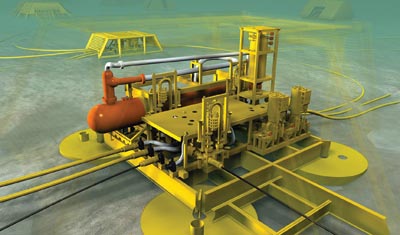
The growth of hub-and-spoke subsea production has introduced a need for long subsea transportation lines. Gas being moved subsea presents problems, and Aker Solutions is working to resolve some of them. One of the company’s initiatives is a subsea gas compressor, which is being added to Aker Solutions’ subsea booster family. A modular compressor pilot unit is being built for potential use on the Ormen Lange field offshore Norway. Upon its completion, anticipated for 2010, the 700-metric-ton compressor unit will be disassembled and shipped to the Nyhamna terminus of the Ormen Lange subsea pipeline, where it will receive extensive environmental testing in a seawater-filled pit for two years. With success, a commercial full-size unit consisting of four compressor trains capable of moving both gas and condensate will be built and installed on the seabed 75 miles (120 km) offshore.
FMC has won awards over the past 18 months for several new types of subsea systems. One noteworthy contract, awarded by Total in January, is for the Pazflor project in deepwater Block 17 offshore Angola, which calls for the first subsea separation systems in deepwater West Africa. Deliveries will begin next year for three gas-liquid separation systems, 49 subsea trees and wellhead systems, three four-slot production manifold systems, production control and umbilical distribution systems, gas export and flowline connection systems, and remotely operated vehicle tooling.
Moving hydrocarbons subsea
The increasing number of subsea and deepwater developments brings new challenges where there are no surface connections to the pipeline available for pipeline testing and pre-commissioning. Once subsea and deepwater systems are built and installed, they have to undergo pre-commissioning and commissioning operations that include initial flooding, gauging, testing, and startup. Providing these services in shallow water and topside-to-topside developments is routine, but providing the same services at water depths greater than 3,000 ft (~1,000 m) poses a lot of challenges.
One of the biggest risks is making and maintaining the connection between the vessel and subsea unit. Today it is possible to flood, gauge, and hydrotest a deepwater pipeline without using any down-line. BJ Process & Pipeline Services has made headway in applying this technique on many pipelines, but as systems go deeper, the challenges grow.
BJ is developing a means to remotely close valves at the discharge end of pipeline being tested. Another project in the works is investigating ways to improve pig detection for both launching and receiving, which will remove the need to “over-pump” during subsea pigging operations. A third development is a means of transmitting real-time test data to surface using acoustic telemetry, a process that was in field trials in mid-2008 and one the company plans to make operational soon.
According to John Grover, in a presentation made earlier this year at the Subsea Asia Conference, next up will be finding a way to combine remote valve closing and remote data transmission and guaranteeing a pig location so that risk during deepwater pipeline pre-commissioning can be further reduced.
Researchers at Texas A&M University, meanwhile, are working on flow assurance issues for deepwater LNG transport pipelines, where temperatures can range from 32°F to 35°F (0°C to 2°C). The main challenge in transporting the LNG through pipes is to keep the gas in liquid state without significant boil-off and to prevent potentially destructive deposits. The objective of the new interstitially insulated coaxial pipe (IICP) insulation technology is to reduce the thermal conductance of the pipe. IICP technology uses strategies that attempt to bring heat transfer rates below those of current technologies.
The technology does not use external insulation, making it more durable than foam-insulated products. Additionally, the reduced footprint allows the pipe to be easily transported and installed without additional expenses at the
日韩情爱电影在线观看|
久久99性xxx老妇胖精品|
国产欧洲精品视频|
午夜影院网站|
亚洲精品国产精品国产自|
美女把尿口扒开让男人桶在线观看|
亚洲狼人国产精品|
毛片视频网站在线观看|
国产精品自拍三区|
爱爱的免费视频|
宅男噜噜噜66国产日韩在线观看|
在线免费视频一区|
欧美呦呦网站|
日韩国产一级片|
91精品尤物|
亚洲乱码国产乱码精品天美传媒|
欧美色999|
国产v亚洲v天堂无码|
在线免费观看污|
日本高清+成人网在线观看|
日韩乱码一区二区三区|
成人动漫av在线|
国产一区二区三区四区在线|
视频在线观看一区|
亚洲精品无码一区二区|
欧美精品国产|
亚洲精品久久久久久宅男|
日韩黄色大片网站|
日韩a在线播放|
欧美猛男做受videos|
日本福利视频一区|
久久大胆人体视频|
精品免费久久久久久久|
成人爽a毛片|
国产精品av免费|
精品三级国产|
在线免费观看成人|
91丨精品丨国产|
日本在线观看一区二区三区|
草民电影神马电影一区二区|
久久伦理网站|
国产精品久久久久久吹潮|
任我爽在线视频精品一|
国产福利亚洲|
日韩欧美一区二区三区久久婷婷|
日韩成人在线电影|
亚洲欧美久久234|
日本一区二区乱|
黄色小视频大全|
国产精品任我爽爆在线播放|
久久观看最新视频|
99精品中文字幕在线不卡|
神马午夜伦理影院|
亚洲肉体裸体xxxx137|
国产成人无码a区在线观看视频|
国产成人一区|
亚洲成熟丰满熟妇高潮xxxxx|
中文字幕av一区二区三区佐山爱|
不卡一卡2卡3卡4卡精品在|
波多野一区二区|
国产在线资源一区|
在线看欧美视频|
亚洲ai欧洲av|
久久伊人久久|
日韩在线视频在线|
天美av一区二区三区久久|
久久国产亚洲精品无码|
欧美日韩伦理在线免费|
男操女免费网站|
在线成人黄色|
aaaaa级少妇高潮大片免费看|
美国毛片一区二区|
人妻久久一区二区|
久久久五月婷婷|
久久国产香蕉视频|
亚洲午夜羞羞片|
色窝窝无码一区二区三区|
欧美亚洲高清一区|
国产精品理人伦一区二区三区|
精品国产sm最大网站免费看|
2018天天操夜夜操|
久久天天躁狠狠躁夜夜躁2014
|
亚欧精品一区|
91国自产精品中文字幕亚洲|
久久五月精品|
粉嫩av免费一区二区三区|
农村妇女一区二区|
污污污污污污www网站免费|
欧洲视频一区|
不卡的一区二区|
久久精品免费看|
久久丫精品久久丫|
亚洲天堂网中文字|
亚洲成人偷拍自拍|
欧美成人艳星乳罩|
制服丝袜影音先锋|
国内伊人久久久久久网站视频
|
欧美日韩免费观看一区|
动漫视频在线一区|
久久久精品三级|
99国产精品自拍|
成人精品一二三区|
国产视频一区二区在线观看|
国产哺乳奶水91在线播放|
欧美日韩国产另类一区|
俺去啦俺在线观看|
欧美极度另类性三渗透|
色呦呦呦在线观看|
图片区小说区区亚洲五月|
色综合中文网|
国产a√精品区二区三区四区|
国产一区二区不卡|
精品人妻一区二区三区潮喷在线|
精品久久久久久久久久久|
91在线免费观看|
久久这里只有精品视频首页|
黄网站在线免费看|
日韩精品电影网站|
精品视频久久|
亚洲精品乱码久久|
91香蕉视频mp4|
国产黄色av片|
精品国产自在久精品国产|
最近中文字幕mv第三季歌词|
国产精品偷伦一区二区|
www.一区|
精品www久久久久奶水|
日日摸夜夜添夜夜添精品视频
|
在线午夜视频|
91久久偷偷做嫩草影院|
中文字幕一区二区三区日韩精品|
亚洲另类第一页|
国产在线精品国自产拍免费|
亚洲av无码精品一区二区|
欧美三级视频在线观看|
国产对白国语对白|
国产日韩欧美在线|
日韩欧洲国产|
97超碰免费在线观看|
成人美女视频在线观看18|
国产成人精品av在线观|
欧美精品一区二|
国产视频精品久久|
日韩av免费电影|
综合天堂av久久久久久久|
老司机成人免费视频|
亚洲韩国精品一区|
免费下载黄色软件|
日本国产欧美一区二区三区|
日本a人精品|
波多野结衣免费观看|
99久久久国产精品|
亚洲aaaaaaa|
日韩亚洲综合在线|
波多野结衣在线播放|
青青草视频在线免费播放|
日韩经典中文字幕一区|
国产91av在线播放|
精品国产三级电影在线观看|
美国一级片在线免费观看视频|
欧美日韩在线一区二区三区|
亚洲国产老妈|
伊人国产在线观看|
精品视频一区二区不卡|
最新在线你懂的|
麻豆传媒一区二区|
91久久高清国语自产拍|
青娱乐在线视频免费观看|
一本色道久久综合精品竹菊|
jlzzjlzz欧美|
超碰97在线资源|
成人羞羞网站入口免费|
成人免费黄色小视频|
一本到高清视频免费精品|
交换国产精品视频一区|
国产日韩三区|
一级毛片免费高清中文字幕久久网|
久久久久亚洲av片无码下载蜜桃
|
精品无码一区二区三区爱欲|
久久精品国产秦先生|
成 人片 黄 色 大 片|
伊人久久免费视频|
高清精品在线|
一区二区三区韩国|
久久综合久久综合九色|
国产最新自拍视频|
国产成人拍精品视频午夜网站|
超碰一区二区三区|
国产高潮呻吟久久|
亚洲国产精品久久人人爱
|
成年人在线看|
国产亚洲精品久久久久久久|
蜜臀a∨国产成人精品|
亚洲AV无码一区二区三区少妇|
少妇高潮 亚洲精品|
亚洲欧洲美洲av|
国产美女视频一区|
欧美日韩乱国产|
欧美精品一区视频|
av网站免费在线观看|
